Coverage
Medical
The physician-facing conversation: practice owners, clinicians, and healthcare operators on the shows that shape private practice.
Refreshed nightly · readings through September 19, 2026
What this page measures
We transcribe every episode of the medical shows listed below and score what gets said in them. Not what analysts predict, and not what a survey panel reports after the fact. What practitioners tell each other while the quarter is still running.
Podcast interviews are unusually good evidence for this. The guest is a working operator, the format is long enough that talking points run out, and nobody is answering a multiple-choice question. When sentiment in a sector turns, it tends to show up in how people talk months before it reaches a published number.
The scores below run 0 to 100 against a 50 neutral baseline, weighted by how much reach an episode has. Readings refresh nightly across a trailing 30-day window. A cut this narrow can go thin in a quiet month, and when it does we say so rather than publishing a number built on four episodes. Full methodology.
What the Medical conversation reads like
Sentiment across the five topics we score, measured only on medical shows. Trailing 30 days against the same window a quarter ago; thin cuts fall back to a 90-day read.
Future Outlook
73.4
Economy
46.0
Industry Forecast
53.1
AI
52.3
Innovation
69.5
Future Outlook
12-mo avg 75.2 · points from average
Economy
12-mo avg 45.8 · points from average
Industry Forecast
12-mo avg 56.9 · points from average
AI
12-mo avg 54.7 · points from average
Innovation
12-mo avg 68.4 · points from average
Each topic against its own 12-month average (the zero line), within medical shows only. Above means the conversation is running hotter than normal for that topic; below, cooler.
Latest in Medical
newest across the tracked shows
Off the Chart: A Business of Medicine Podcast
Sep 17, 2026
S1 Ep186: When physicians know the right care and can't give it, with Rebecca Schoon of Pacific University
Dr. Rebecca Schoon, associate professor of public health at Pacific University and board member of Healthcare for All Oregon, discusses moral injury among physicians in a profit-driven healthcare system. The episode examines Oregon's response to corporate consolidation of medical practices, including the 2025 law restricting corporate control of medical entities, and explores the state's push toward universal healthcare through its Universal Health Plan Governance Board.
Money Meets Medicine
Sep 16, 2026
How FOMO Real Estate Deals Cost Doctors
Money Meets Medicine hosts Dr. Jimmy Turner and Justin Harvey (CFP) address three physician financial questions: the tax pitfalls of real estate syndications for W-2 earners, strategies to rebalance a concentrated stock position without excessive capital gains tax, and a framework for deploying large December bonuses. The episode emphasizes the importance of understanding passive activity loss rules, considering charitable giving through donor-advised funds, and aligning bonus allocation with personal financial goals and tax liabilities.
BootstrapMD - Physician Entrepreneurs Podcast with Dr. Mike Woo-Ming
Sep 16, 2026
EP363: From Owning a Job to Building a Sellable Medical Practice
Dr. Jean-Raphael Schneider, a practicing neurologist who built and sold his own multi-provider neurology practice, discusses how he transformed his medical practice from a self-employed job into a scalable, sellable business asset using lean methodology. Drawing on his mother's supply chain background from Hewlett Packard, Schneider implemented systems including standardized order sets, efficient patient scheduling, and ancillary services (infusion and research) that allowed his practice to run without complete dependence on his direct involvement. The episode covers the three pillars of a valuable medical practice (systems, ancillary services, and multiple providers), operational inefficiencies and financial safeguards including his experience with cyber fraud, and how physicians can transition from ownership of a job to ownership of a true business.
The Family Practice Podcast
Sep 15, 2026
115. Why Your Adult Patients Need More Than Structural Pain-Based Care
Dr. Tony Ebel presents a clinical training on neurologically focused, subluxation-based "neurotonal" chiropractic care for adult patients, emphasizing lifetime care and nervous system restoration rather than short-term pain relief or X-ray-driven corrective approaches. He outlines three stages of neurological dysfunction and contrasts aggressive structural correction with a sequenced neurotonal approach using varied forces to release tension, reorganize, and recharge exhaustion. The episode covers how to examine, analyze, and adjust adult patients using HRV, EMG, and thermal scans while progressively improving both neurological function and spinal structure without worsening patient outcomes during care.

The Testing Psychologist Podcast
Sep 14, 2026
599. Recognizing AuDHD: Avoiding Diagnostic Pitfalls in Co-occurring Autism and ADHD w/ Dr. Sara Woods
Dr. Sara Woods, clinical psychologist at the University of Washington Autism Center and Discover Psychology, discusses AuDHD—the co-occurrence of autism spectrum disorder and ADHD—as an emerging construct that may represent a qualitatively different presentation than the simple sum of two diagnoses. The episode explores community-identified characteristics, neurobiological evidence, lifespan clinical presentations from childhood masking to adult niche-seeking, diagnostic pitfalls including overshadowing and masking, and practical assessment and support considerations.
Off the Chart: A Business of Medicine Podcast
Sep 14, 2026
S1 Ep185: Who gets paid when the AI does the work? with Caroline Pearson of the Peterson Health Technology Institute
Caroline Pearson, executive director of the Peterson Health Technology Institute, discusses how payment models—not technology itself—will determine whether clinical AI reduces or inflates healthcare costs. The conversation explores the risks of fee-for-service reimbursement for AI tools, the distinction between assistive and autonomous AI, liability questions when AI makes medical errors, and emerging direct-pay models that could bypass physicians entirely.
The Medical roster
7 showsThe Testing Psychologist Podcast
Dr. Jeremy Sharp: Licensed Psychologist & Private Practice Consultant
Helping psychologists, neuropsychologists, and mental health professionals start, grow, and scale psychological testing services in private practice.
Money Meets Medicine
The Physician Philosopher
On Money Meets Medicine, Dr. Jimmy Turner discusses all things career and finance for physicians. With expert guest discussions, Jimmy tackles the personal finance topics you wish…
Off the Chart: A Business of Medicine Podcast
Medical Economics
Off the Chart: A Business of Medicine Podcast features lively and informative conversations with health care experts, opinion leaders and practicing physicians about the…
The Doctors On Social Media Podcast
Dana Corriel, MD
This podcast was created by founder Dr. Dana Corriel, who built the SoMeDocs brand (SoMeDocs being short for "Doctors on Social Media") from the ground up. The podcast plans to…
The Family Practice Podcast
Dr. Tony Ebel
Welcome to The Family Practice Podcast , the podcast for students + chiropractors seeking to ignite and scale a pure principled, successful, and WILDLY fulfilling Family…
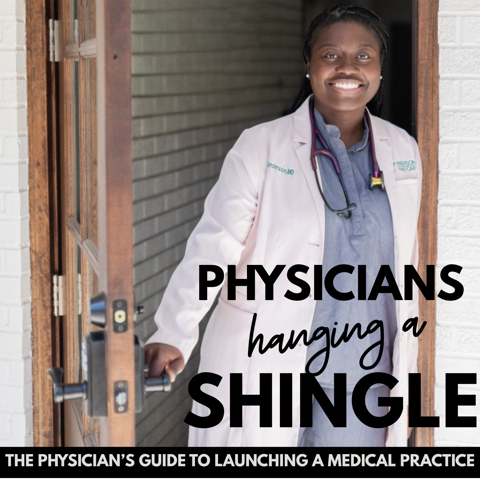
Physicians Hanging a Shingle | Start a Private Medical Practice
Brittney Anderson, MD, FAAFP | Physician and Practice Owner
A physician-hosted podcast dedicated to guiding other physicians through the steps of successfully starting a private medical practice. Have you considered launching a private…
BootstrapMD - Physician Entrepreneurs Podcast with Dr. Mike Woo-Ming
Mike Woo-Ming
BootstrapMD -A podcast for doctors and physician entrepreneurs who want to learn to increase their financial worth and bring balance to your work life. We discuss building side…
Need this cut deeper?
Term-level trends, competitor mentions, and custom segments within the medical conversation are available as custom research. See the Conversation Index or get in touch.