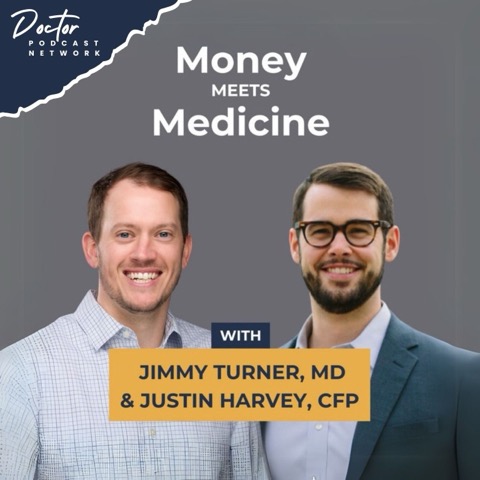
Money Meets Medicine
The Physician Philosopher
On Money Meets Medicine, Dr. Jimmy Turner discusses all things career and finance for physicians. With expert guest discussions, Jimmy tackles the personal finance topics you wish you had learned in medical school. The MMM podcast will help you tackle your student loans, achieve financial independence, invest for retirement, and decrease your financial stress and burnout. To get help with free educational content or obtaining own-occupation disability insurance from a source you know you can…
Recent Episodes
How FOMO Real Estate Deals Cost Doctors
Sep 16, 2026Money Meets Medicine hosts Dr. Jimmy Turner and Justin Harvey (CFP) address three physician financial questions: the tax pitfalls of real estate syndications for W-2 earners, strategies to rebalance a concentrated stock position without excessive capital gains tax, and a framework for deploying large December bonuses. The episode emphasizes the importance of understanding passive activity loss rules, considering charitable giving through donor-advised funds, and aligning bonus allocation with personal financial goals and tax liabilities.
HSAs, Donor Advised Funds, and When to Drop Insurance
Sep 9, 2026Hosts Dr. Jimmy Turner and Justin Harvey address three listener questions on physician personal finance: whether HSA-eligible plans make sense during high healthcare usage periods like pregnancy, tax-efficient charitable giving strategies including donor-advised funds and appreciated securities gifting, and when physicians with substantial net worth should discontinue life and disability insurance premiums. The discussion emphasizes personalized analysis and consulting qualified financial professionals.
457 Plans, Bonus Investing, and Emergency Funds
Sep 2, 2026Dr. Jimmy Turner and Justin Harvey answer three listener questions on retirement planning and investing. They discuss 457 plans—distinguishing between governmental and non-governmental versions and outlining three key evaluation criteria (employer viability, distribution flexibility, and investment options). They also address lump-sum investing versus dollar-cost averaging for bonus money, citing research showing 70% of the time lump-sum investing outperforms despite psychological appeal of DCA. Finally, they tackle emergency fund sizing for physicians, emphasizing that the standard 3–6 months guideline is highly personal and depends on career stage, net worth, and access to other liquidity sources.
Part-time work, Paying Off Loans, & Funding Kids College
Aug 26, 2026Dr. Jimmy Turner and CFP Justin Harvey answer three listener questions spanning different career stages: whether residents should pay extra on federal student loans under the Repayment Assistance Plan, the financial math of transitioning to part-time work as an attending physician, and how parents should approach funding their child's undergraduate and medical school education given new federal borrowing limits.
5 Bad Pieces of Financial Advice to Avoid
Aug 19, 2026Dr. Jimmy Turner and Justin Harvey discuss six common pieces of financial advice that are particularly harmful for physicians. They cover disability insurance company selection and timing, inadequate savings rates for delayed earners, student loan consolidation changes under recent legislation, the myth that debt payoff should precede investing, the flexibility costs of early home purchases, and the limitations of asking whether an advisor is a fiduciary. The hosts emphasize that physicians face unique financial circumstances—delayed earnings, substantial debt, and different time horizons—that make generic financial advice risky.
Should I Invest in SpaceX? (Lessons from SpaceX IPO)
Aug 12, 2026Dr. Jimmy Turner and Justin Harvey, CFP, discuss the SpaceX IPO and its implications for index fund investing. They explain how index inclusion criteria work—seasoning periods, profitability requirements, and float—and examine why the S&P 500 excluded SpaceX while NASDAQ, Russell 1000, and CRSP relaxed their rules to include it. The hosts explore the mechanics of IPOs, the role of private investor liquidation, and the risks retail investors face when buying newly public companies, with lessons applicable to upcoming AI company IPOs like Anthropic and OpenAI.
Are Doctors Fairly Paid? Inside the 2026 Compensation Data
Aug 5, 2026Jimmy Turner and Justin Harvey analyze Medscape's 2026 physician compensation report, which surveyed approximately 6,000 doctors across 29+ specialties. They examine four key findings: 28% of physicians report earnings below family needs despite earning $266K–$417K; a paradox where 53% feel personally fairly compensated but 61% believe the profession is underpaid; 70% of doctors rarely or never negotiate compensation due to employer "no negotiation" policies; and 40% maintain side gigs outside clinical medicine. The hosts discuss how fixed compensation models suppress high performers, moral injury from insurance denials, and why autonomy losses drive physicians toward entrepreneurship.
Red Flags in Private Practice Job Offers
Jul 29, 2026Michael Johnson, a physician contract attorney, discusses red flags and evaluation strategies for private practice partnership opportunities with Dr. Jimmy Turner. The episode breaks down the critical distinction between partnership in name versus actual ownership, guides physicians through pre-ownership track compensation analysis, and explores real estate and facility fee ownership structures. Johnson provides eight essential questions physicians should ask when evaluating partnership buy-in opportunities to avoid costly mistakes.
Trump Accounts: What You Need to Know
Jul 22, 2026Dr. Jim Turner and Justin Harvey discuss Trump Accounts (530A accounts), a new government program launched July 4, 2025, that provides $1,000 in government funding for children born during Trump's tenure (2025-2028) and allows parents to contribute up to $5,000 annually. The hosts explore the mechanics of these child-owned accounts, their similarities to traditional IRAs, tax implications including basis tracking, and where they fit in a savings hierarchy relative to 529 plans, Roth IRAs, and other investment vehicles. They address who should consider these accounts, behavioral finance concerns around giving large sums to 18-year-olds, and the importance of aligning account decisions with personal financial goals and values.
Physician Tax Strategy: W2 vs 1099 vs K1
Jul 8, 2026Spencer Carroll, a CPA and leading account executive at Gelt, discusses advanced tax strategy for physicians across different income structures. The episode covers why W2 income offers limited tax optimization opportunities, how 1099 and K1 business ownership unlock significant tax benefits, S Corp strategy and reasonable salary determination, and the role of AI-powered tools in modern tax planning. Carroll emphasizes that effective tax strategy requires complexity—ideally through business ownership—and warns against pursuing tax strategies solely for their deductions without sound underlying investments.
Show artwork and metadata belong to the publisher and are shown here editorially, as part of documenting the corpus behind our analyses. Inclusion does not imply any endorsement of, or by, Parsed Analytics.