The Big Unlock
Rohit Mahajan
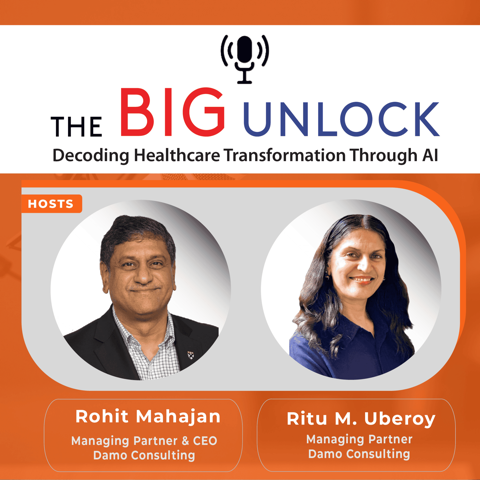
THE BIG UNLOCK PODCAST is a Healthcare Digital Transformation Podcast. Stay Updated on Healthcare’s Digital Transformation Trends. Featuring C-suite Leaders and Insights on Digital Health Innovation. Explore Emerging Healthcare Technologies with Rohit Mahajan and Ritu M. Uberoy.
Recent Episodes
Episode 226 – Healthcare AI Requires Workflow Transformation, Not Just Technology
Sep 16, 2026Roberta Schwartz, Executive Vice President and Chief Innovation Officer at Houston Methodist Hospital, discusses how healthcare organizations must move beyond AI hype toward outcomes-driven innovation that requires workflow transformation, not just technology deployment. She shares Houston Methodist's approach to evaluating AI and agentic technologies through a center of innovation that brings together IT leaders and operators to measure impact on care quality, workforce satisfaction, and cost reduction. Key examples include a 95% patient satisfaction scheduling bot (Zoe) that required process redesign before technology implementation, and expansion of virtual care and centralized specialty services to address access challenges. Schwartz emphasizes that successful AI adoption requires skepticism, clearly defined trials, rigorous outcome measurement, and a commitment to improving care, strengthening the workforce, and reducing costs simultaneously.
Episode 225 – Moving Healthcare AI from Conversation to Execution
Sep 8, 2026Shailu Verma, CEO and Co-founder of Mila Health, discusses how healthcare AI is transitioning from conversational tools to executable AI agents that automate care coordination workflows. He explains Mila's API-first architecture that embeds directly into existing clinical software systems, enabling rapid deployment across 300+ dental organizations. Verma emphasizes that successful AI implementation requires focus on measurable ROI, human-in-the-loop safeguards, and solving specific operational problems like patient outreach and appointment scheduling rather than pursuing broad point solutions.
Episode 224 – AI Can Augment Clinical Judgment Without Replacing It
Sep 1, 2026Dr. Ami Bhatt, Chief Medical Officer at WHOOP and former Chair of the FDA Digital Health Advisory Committee, discusses how healthcare can leverage AI to augment—not replace—clinical judgment. She emphasizes that AI serves as a source of compute power to surface knowledge and identify patterns, while clinical acumen remains central to decision-making. The conversation covers patient-centered design, agentic AI guardrails, post-deployment monitoring, real-world evidence, and the need for healthcare leaders to prepare for constant technological change.
Episode 223 – From Legacy Systems to AI-Native Healthcare in Rural America
Aug 25, 2026Michael Archuleta, CIO of Mount San Rafael Hospital in rural Colorado, discusses the hospital's transformation into a nationally recognized digital innovator through strategic technology investments, particularly the transition to an AI-native Oracle Health platform. He emphasizes that digital transformation must follow the patient journey rather than legacy system constraints, and positions cybersecurity as a patient safety issue requiring continuous testing, workforce awareness, and a strong human firewall. Archuleta shares how rural health systems can leapfrog legacy limitations through AI, remote patient monitoring, and interoperability, while reframing the CIO role from cost center to strategic business leader focused on operational excellence and patient outcomes.
Episode 222 – AI is Moving Drug Discovery From Prediction to Generation
Aug 20, 2026Alex Zhavoronkov, Founder, CEO and CBO of Insilico Medicine, discusses how generative AI is transforming drug discovery from molecular prediction to generation, enabling the company to move from target identification to clinical candidates faster. Insilico, a publicly traded clinical-stage biotech (Hong Kong ticker 3696), orchestrates specialized AI models across biology, chemistry, and clinical development, with multiple programs in human trials spanning cancer, chronic lung disease, inflammatory bowel disease, neurodegeneration, and pain. Zhavoronkov argues that while AI dramatically expands the experimental search space, the inherent complexity of biology ensures failure remains inevitable—requiring rigorous validation, peer-reviewed evidence, and real-world data. His core ambition is leveraging AI-driven drug discovery to extend human lifespan and health span, positioning longevity as the most important human problem.
Episode 221 – Making Human Movement Measurable with AI
Aug 18, 2026Zaw Thet, CEO and Co-founder of Exer AI, discusses how AI-powered computer vision makes human movement measurable and transformable for clinical care. The conversation covers Exer's platform deployment across orthopedics, neurology, rehabilitation, and telehealth, focusing on how real-time movement assessment improves patient outcomes, clinical efficiency, and access to care. Thet emphasizes the importance of clinical validation, regulatory compliance, and keeping humans in the loop as AI scales in healthcare.
Episode 220 – Cloud and AI Are Reshaping Healthcare Transformation
Aug 11, 2026Dr. Angela Shippy, Senior Physician Executive and Clinical Innovation Lead at Amazon Web Services, discusses how cloud and AI are transforming healthcare at enterprise scale. She explains that successful AI adoption requires secure cloud infrastructure, clean data foundations, responsible governance, and workforce upskilling—not just powerful models. Through examples like UCSD's use of Amazon Connect Health and AWS's antimicrobial resistance surveillance initiative, she illustrates how leading health systems are moving beyond isolated pilots to solve well-defined clinical and operational problems, while agentic AI workflows promise to reduce administrative burden and enable clinicians to focus on direct patient care.
Episode 219 – Health Literacy is Key to Better Patient Outcomes
Aug 4, 2026Greg O'Neill, Director of Patient & Family Health Education at ChristianaCare, discusses how health literacy and effective communication drive better patient outcomes in healthcare systems. Drawing on his background as an ICU nurse and advanced practice nurse, Greg explains ChristianaCare's approach to embedding plain language, personalized content, and technology into clinical workflows while maintaining the human connection essential to trust. He explores AI's potential to reduce cognitive burden for patients, break down fragmented care systems, and highlights the partnership with FDB on multilingual medication calendars as a practical example of health literacy-centered digital tools.
Episode 218 – Using Multimodal Foundations and Ambient AI to Scale Clinical Impact
Jul 28, 2026Umesh Rasogi, General Manager of Microsoft Healthcare and Life Sciences, discusses the development and deployment of Dragon Copilot, an AI clinical assistant designed specifically for nursing workflows. The episode explores how multimodal AI foundations and ambient listening technology can reduce nurse burnout and administrative burden, while addressing the critical balance between innovation velocity and responsible AI governance in healthcare settings.
Episode 217 – Building Trust in the Next Generation of Healthcare AI
Jul 21, 2026Dr. Heather Varech, a cardiologist and Program Manager at ARPA-H, discusses the Advocate program—a federal initiative to develop patient-facing generative AI for clinical care, specifically targeting heart failure management. The conversation explores how ARPA-H bridges the gap between rapid AI innovation and traditional regulatory pathways, emphasizing the need for ambitious yet scoped projects, close FDA collaboration, and rigorous evaluation frameworks that build public trust in clinical AI technologies.
Show artwork and metadata belong to the publisher and are shown here editorially, as part of documenting the corpus behind our analyses. Inclusion does not imply any endorsement of, or by, Parsed Analytics.