The most consequential AI pricing event of the past year did not come from an American lab. DeepSeek and Qwen, Chinese models released with open weights, put frontier-adjacent capability on the table at a fraction of frontier prices, and forced a question every AI-dependent company will eventually face: keep paying the frontier labs, or build on open models you can run yourself?
The stakes are not abstract. Open weights change the cost structure, the vendor lock-in, the data-control story, and, because these particular models are Chinese, the geopolitics of the answer. It is a procurement question, a security question, and an industrial-policy question wearing the same clothes.
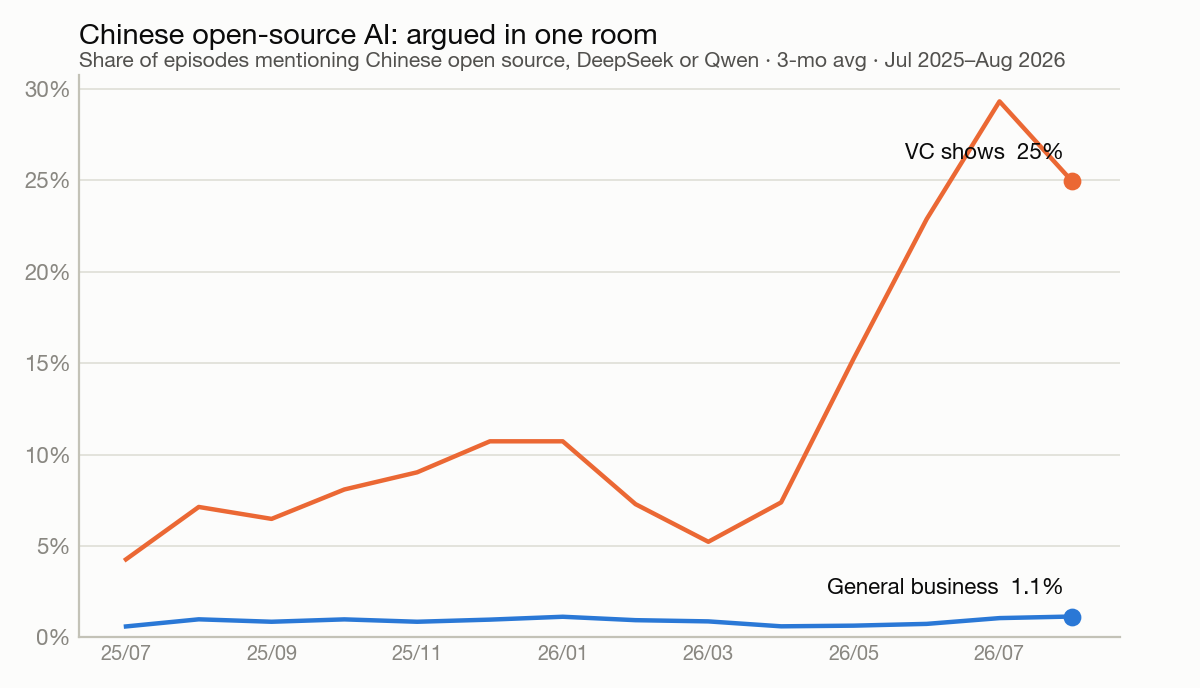
Right now, that debate is being argued almost entirely in one room. One in five VC interviews over the last six months touches Chinese open-source models, up from under 8% in the six months before. In general business conversation the subject barely exists: 1.3% before, 1.3% now. The VC world is stress-testing a question operators have not started asking.
The surrounding vocabulary shows how live the debate is where it is happening. "Open weight" mentions are up 1,845% since February, "open models" up 1,210%, "frontier labs" up 829% with a perfect month-over-month streak. The frame itself, open versus frontier, is new language, and new language is how markets think out loud before they act.
VC conversation runs ahead of operator conversation by months. That gap is the useful part. DeepSeek was flaggable the moment it broke into the VC lane, well before mainstream business conversation noticed, and the same migration pattern is the thing to watch here: subjects like this start as portfolio strategy and arrive later as a line in an RFP.
So the number that matters is not the VC 20%. It is the general business 1.3%. Token costs made that exact journey this year, 1.3% to 6.4% in six months, when the AI bill got real. When the open-model debate makes the same move, the buy-versus-build question will have landed on the operator's desk. It will be visible when it moves.
Data: share of episodes mentioning "Chinese open source," "DeepSeek," "Qwen," or "Chinese models," by vertical and publish period, across ~24,000 business podcast transcripts, July 2025 through August 2026.
Chinese open-source AI mentions reach 20% of VC interviews, up from 8% six months ago, while general business conversation sits flat at 1.3%. The gap between the two lanes is the leading indicator to watch.